 All Itineraries
The Balkans in 3 Weeks: Croatia to Albania
Zagreb to the Albanian Riviera — medieval cities, island ferries, and undiscovered beaches
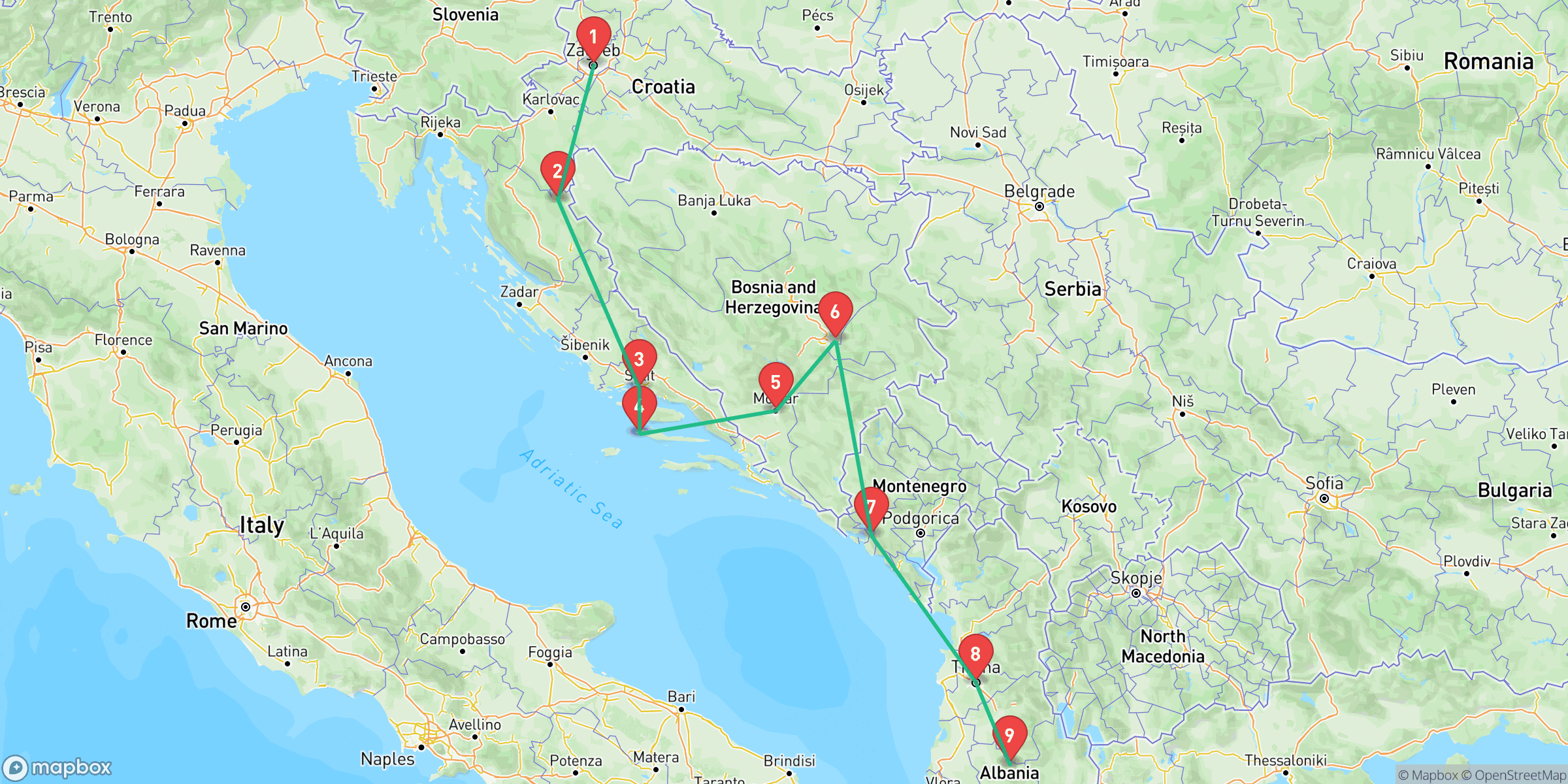
This 21-day Balkan itinerary crosses six countries from Croatia's capital down to Albania's sun-bleached coast: one day in Zagreb's Austro-Hungarian café culture, a day at Plitvice Lakes' waterfall-linked turquoise pools, three days in Split exploring the living Roman palace, two days island-hopping to Hvar and Korčula, a powerful stop in Mostar's Ottoman quarter, two days in Sarajevo's layered history of empire and siege, three days in Kotor's dramatic Adriatic fjord, two days in Tirana's colourful post-communist centre, and a final three days on Albania's near-empty Riviera beaches and the UNESCO hill-town of Berat.
At a glance
- Duration
- 3 weeks
- Stops
- 9
- Daily budget
- EUR 40–70
- Total estimate
- EUR 840–1,470
- Best months
- May, Jun, Sep
- Difficulty
- moderate
Estimates include lodging, food, local transport. Excludes flights.
Cover this trip
Nomad-style travel insurance from SafetyWing — medical, evacuation, lost luggage. From ~$45/month.
Customize this trip
Adjust dates, swap destinations, get an AI day-by-day plan with restaurants and activities.
Free to start, no card required
Stops on this route
Zagreb
Croatia
- Upper Town (Gornji Grad) & St. Mark's Church
- Museum of Broken Relationships
- Dolac market & craft beer on Tkalčićeva
Plitvice Lakes
Croatia
- Lower Lakes waterfall boardwalk trail
- Veliki Slap — Croatia's tallest waterfall (78 m)
- Electric boat and footbridge loop routes
Split
Croatia
- Diocletian's Palace — a Roman emperor's retirement home turned living city
- Marjan Hill forest park & viewpoint
- Riva waterfront promenade & fish market
Hvar & Korčula
Croatia
- Hvar Town lavender fields & hilltop fortress
- Korčula old town — Marco Polo's alleged birthplace
- Ferry island-hopping the Dalmatian coast
Mostar
Bosnia and Herzegovina
- Stari Most (Old Bridge) — rebuilt Ottoman arch over the Neretva
- Kujundžiluk bazaar coppersmith street
- Blagaj Tekke Sufi monastery at a river source
Sarajevo
Bosnia and Herzegovina
- War Tunnel Museum (Tunel spasa) under the airport
- Baščaršija Ottoman bazaar & Gazi Husrev-beg Mosque
- Yellow Bastion sunset viewpoint over the valley
Kotor
Montenegro
- Kotor Old Town city walls & St. Tryphon Cathedral
- Bay of Kotor (Boka Kotorska) fjord boat trip
- Perast village & Our Lady of the Rocks island church
Tirana
Albania
- Blloku neighbourhood café culture & colourful boulevards
- National History Museum mosaic facade
- Bunk'Art communist bunker museum
Berat & Albanian Riviera
Albania
- Berat 'City of a Thousand Windows' UNESCO white houses
- Ksamil turquoise lagoon beaches near Saranda
- Llogara Pass mountain road & Riviera coastal views
Day by Day
- 1
Zagreb
- Day 1
Arrive in Zagreb — Upper Town & Tkalčićeva
TransitFly into Zagreb Airport and take the Croatia Airlines bus or a 20-minute taxi (around €15) to the city centre. Spend the afternoon walking the cobblestoned Upper Town (Gornji Grad): the colourful tiled St. Mark's Church, Lotrščak Tower with its noon cannon, and the funicular up from Lower Town. Evening: the pedestrian street Tkalčićeva is Zagreb's most atmospheric strip for dinner and local craft beer — try a rakija flight at a konoba before an early night.
- 2
Plitvice Lakes
- Day 2
Bus to Plitvice — Waterfall Boardwalk Loop
TransitTake an early morning bus from Zagreb bus station to Plitvice Lakes National Park (2.5 hours, ~120 HRK/€16). Buy your ticket at the entrance (€23-40 depending on season) and start with the Lower Lakes Route H circuit — wooden boardwalks lead through cascades between 16 terraced lakes coloured vivid turquoise by dissolved minerals. Veliki Slap, Croatia's highest waterfall at 78 m, is a 20-minute walk from Entrance 2. Take the electric boat across the largest lake for the upper section. Stay overnight in the park or at Mukinje village to catch the morning light before buses fill.
- 3
Split
- Day 3
Bus to Split — Diocletian's Palace
TransitTake a bus from Plitvice to Split (5 hours via Zagreb, or direct seasonal buses). Diocletian's Palace is one of the most unusual places to stay in Europe: a 4th-century Roman emperor's retirement complex whose walls now enclose restaurants, bars, apartments, and the cathedral built inside his mausoleum. Wander the labyrinthine lanes of the palace interior, climb to the Peristyle for a coffee with cathedral views, and walk the Riva promenade along the harbour for sunset. Drop your bags at a hostel within the palace walls.
- Day 4
Marjan Hill, Fish Market & Grad Nightlife
Hike the Marjan forest park trails for panoramic views over the coast and Brač island — the path to Telegrin viewpoint takes 40 minutes and passes old chapels and Jewish cemetery ruins. Back in the city, browse the morning fish market (Ribarnica) below the palace for grilled brancin and fresh oysters. Split has an increasingly lively nightlife scene centred on the palace cellars and Puls1 and Puls2 bars — the ideal warm-up for your island days ahead.
- Day 5
Day Trip to Brač — Golden Horn Beach
Take the morning Jadrolinija ferry from Split to Supetar on Brač island (50 minutes, €4 each way). Rent a scooter or take a local bus to the famous Zlatni Rat (Golden Horn) beach near Bol — an arrow-shaped shingle spit that shifts direction with the wind and is one of Croatia's most photographed spots. Swim in clear Adriatic water, rent a windsurf or SUP board, and return to Split on the late afternoon ferry. Pick up your Hvar ferry ticket for tomorrow.
- 4
Hvar & Korčula
- Day 6
Ferry to Hvar — Lavender Fields & Hilltop Fortress
TransitTake the morning catamaran from Split directly to Hvar Town (1 hour, ~€15). The island's lavender fields, umbrella pines, and Venetian architecture make it one of the Adriatic's most beautiful stops. Climb the 13th-century hilltop fortress (Fortica) for sweeping views over the harbour and the Pakleni islands below — entry is €3 and the climb takes 15 minutes. Hvar's harbour fills with superyachts in high season, but May and September the pace is blissfully slow and prices half what they are in July and August.
- Day 7
Ferry to Korčula — Marco Polo's Town
TransitTake the local ferry from Hvar to Korčula Town (2.5 hours via Drvenik or direct catamaran). Korčula's old town sits on a small peninsula with a herringbone street layout designed to channel sea breezes in summer — the city claims to be the birthplace of Marco Polo, and a tower bearing his name is open to visitors. Rent a bike to explore the wine route through Pošip and Grk vineyards that make the island famous among Croatian sommeliers. Overnight in Korčula before bussing south toward Montenegro.
- 5
Mostar
- Day 8
Ferry & Bus to Mostar — Stari Most Bridge
TransitTake the ferry back to the mainland and a bus through Dubrovnik or directly to Mostar (allow a long travel day of 6-7 hours total). Arrive in Mostar and walk straight to the Stari Most, the rebuilt 16th-century Ottoman arch bridge — the original was destroyed in 1993 during the Bosnian War. The kujundžiluk coppersmith bazaar nearby is lined with artisans hammering copper trays and selling hand-painted shell casings, a jarring but honest souvenir of the region's recent history. Watch bridge divers leap into the Neretva from the parapet if the season is warm enough.
- Day 9
Blagaj Tekke, Počitelj & Mostar Old Town
Hire a taxi for a half-day circuit to Blagaj village (10 km from Mostar), where the Blagaj Tekke Dervish monastery clings to a cliff face above the source of the Buna River — the turquoise water emerges ice-cold from a cave at the base of a 200 m vertical rock face. Continue to the medieval fortified village of Počitelj before returning to Mostar for lunch at a riverside ćevabdžinica (restaurant selling ćevapi sausages with fresh pita bread and kajmak cream, around €4 a portion). Afternoon free to explore Mostar's many mosques and the Catholic bell tower.
- 6
Sarajevo
- Day 10
Bus to Sarajevo — Baščaršija Ottoman Quarter
TransitTake a bus from Mostar to Sarajevo (2.5 hours, ~10 KM/€5). Sarajevo is one of Europe's most culturally layered capitals — Ottoman, Austro-Hungarian, Yugoslav socialist, and post-war Bosnian architecture stand within a few blocks of each other. Check into a guesthouse near the Baščaršija bazaar, the copper-domed 16th-century market heart of the city, and eat a burek pastry from a buregdžinica for under €2. Walk to the Latin Bridge where Archduke Franz Ferdinand was assassinated in 1914, sparking the First World War — a modest plaque marks the exact spot.
- Day 11
War Tunnel Museum, Yellow Bastion & Sarajevo Roses
The Tunnel of Hope (Tunel spasa) is the most affecting war-era museum in the Balkans: an 800 m passage dug by hand under the airport runway in 1993 to supply the besieged city with food, weapons, and medicine — you can walk the preserved 25 m section and watch archive footage that makes the survival extraordinary. Back in the city, look for Sarajevo Roses: mortar crater scars filled with red resin to commemorate victims. Hike to the Yellow Bastion (Žuta tabija) for the best sunset views over the minaret-studded valley. End with dinner of slow-cooked begova čorba (bey's soup) at a traditional restaurant.
- 7
Kotor
- Day 12
Bus to Kotor — Bay Arrival & Old Town Walls
TransitTake the morning bus from Sarajevo to Kotor via Trebinje and Herceg Novi (5-6 hours, ~€15-20). The route drops from Bosnian highlands to the Adriatic coast at Herceg Novi then follows the sinuous Bay of Kotor — the world's southernmost fjord — to the medieval walled city at its innermost point. Check in and immediately climb the 1,355 steps to St. John's Fortress above the old town (€8 entry) for extraordinary views of the bay glittering below the Lovćen mountains. The old town itself — a UNESCO World Heritage site — can be walked in 30 minutes but rewards an evening of slow café-lingering.
- Day 13
Perast & Our Lady of the Rocks — Bay Boat Trip
Take a public bus (€2.50, 20 minutes) or a taxi-boat along the bay to Perast, a remarkably preserved Baroque village of palaces and bell towers clinging to the shoreline. Row or hire a water taxi to the tiny artificial island of Our Lady of the Rocks (Gospa od Škrpjela) — locals have been adding stones and shipwrecked boats to build the island up since 1452, and the church ceiling is completely covered with votive silver plaques. Return to Kotor for the afternoon and walk the Ladder of Cattaro trail above the walls to the monastery of Sv. Ivan for bay views.
- Day 14
Lovćen National Park & Njegoš Mausoleum
Hire a driver or join a half-day tour to Lovćen National Park (€20-30 per person). The serpentine road climbs from sea level to 1,660 m in 25 km — 25 hairpin bends with increasingly spectacular views over the bay. At the summit, 461 steps lead to the Njegoš Mausoleum, a striking neoclassical tomb of Montenegro's poet-bishop national hero, with panoramic views stretching from Albania to Dubrovnik on clear days. Afternoon: kayaking in the bay from Kotor town is an easy half-day activity with multiple rental outfits on the waterfront.
- 8
Tirana
- Day 15
Bus to Tirana — Blloku & Bunk'Art
TransitTake a morning bus from Kotor to Tirana via Shkodër (5-6 hours, ~€15). Albania uses the lek (ALL) — €1 ≈ 105 ALL — and is the cheapest country on this itinerary by a wide margin. Drop your bags and head to Blloku, the once-forbidden neighbourhood reserved for Communist Party elites that now houses Tirana's trendiest cafés and bars. Visit Bunk'Art 2 near Skanderbeg Square, a Cold War nuclear bunker converted into a museum of Albania's brutal Hoxha-era political repression — the exhibits are sobering and the tunnels fascinating.
- Day 16
National History Museum, Et'hem Bey Mosque & Mount Dajti
Start at the National History Museum on Skanderbeg Square — the enormous socialist mosaic on the facade is one of the most striking pieces of communist-era public art in Europe, and inside the collection traces Albanian history from Illyrian tribes to the 1990 democratic revolution. Cross the square to the Et'hem Bey Mosque, one of few religious buildings to survive the Communist-era ban on religion. Afternoon: take the Dajti Ekspres gondola (€6.50 return) up Mount Dajti (1,613 m) for a sweeping panorama over the whole city and the coastal plain.
- 9
Berat & Albanian Riviera
- Day 17
Bus to Berat — City of a Thousand Windows
Take a furgon (shared minivan, €6, 2.5 hours) from Tirana's Kombinat station to Berat. The UNESCO-listed city's Ottoman whitewashed houses cling to the hillside in two neighbourhoods — Mangalem below and Gorica across the Osum River — their rows of arched windows stacked like eyes watching the valley, hence the nickname. Climb to Berat Castle (kala) for free and wander the inhabited fortress village inside its walls — people still live, keep chickens, and run guesthouses in houses built against the Byzantine ramparts.
- Day 18
Onufri Museum, Gorica Bridge & Osum Canyon
TransitVisit the Onufri Icon Museum inside the Cathedral of the Dormition — Onufri was a 16th-century Albanian master painter whose vivid tempera icons are remarkable for their intense crimson pigment. Cross the single-arch Ottoman stone bridge to Gorica neighbourhood for quieter lanes and valley views. Optional: hire a driver (€40-50 round trip) to visit the Osum Canyon, a dramatic limestone gorge 26 km east of Berat where the river runs turquoise through 100 m cliffs — kayaking is possible in spring. Take an afternoon furgon toward Sarandë.
- Day 19
Llogara Pass — Albanian Riviera Coastal Drive
TransitBus or shared taxi over the Llogara Pass (1,027 m) — one of the most spectacular road descents in Europe, through pine forest then straight down to the Ionian coast with a view of the entire Albanian Riviera laid out below. Beaches such as Palasa, Himara, and Lukova have warm clear water and almost no tourist infrastructure compared to Croatia — a beach sun lounger costs €2-3 rather than €15-20. The Riviera road hugs the cliff with turnoffs to hidden coves all the way south to Sarandë.
- Day 20
Ksamil Lagoon Beaches & Butrint Ancient Ruins
Ksamil village near Sarandë has three small offshore islands accessible by 5-minute water taxi (€2), surrounded by luminously shallow turquoise water that rivals the Caribbean — arrive by 9 AM before day-trippers from Corfu arrive. Take an afternoon bus or taxi (€15) to Butrint National Park: a UNESCO site where Greek, Roman, Byzantine, and Venetian ruins layer on top of each other in a forested lakeside setting — an amphitheatre, baptistery mosaic floor, and lion-carved gate are the highlights. Dinner back in Sarandë with fresh grilled fish.
- Day 21
Depart — Ferry to Corfu or Fly from Tirana
TransitFrom Sarandë, a 30-minute high-speed ferry (€19, operated by Finikas Lines or Ionian Seaways) connects to Corfu Town, Greece — from where you can fly internationally to most European cities, making this a natural end point for the trip. Alternatively, take a 4.5-hour bus back to Tirana's Mother Teresa International Airport for a wider choice of direct flights. Either way, leave a morning buffer — Albanian furgons and buses run on approximate schedules, and Sarandë's small port is worth a final swim before departure.
Related Itineraries
Europe Backpacking in 3 Weeks
Paris to London — art, pasta, Alps, and canals
Iceland Ring Road in 10 Days
Reykjavik to the East Fjords and back — volcanoes, glaciers, and the midnight sun
Italy in 2 Weeks
Rome to Amalfi — ancient ruins, Renaissance art, and coastal villages
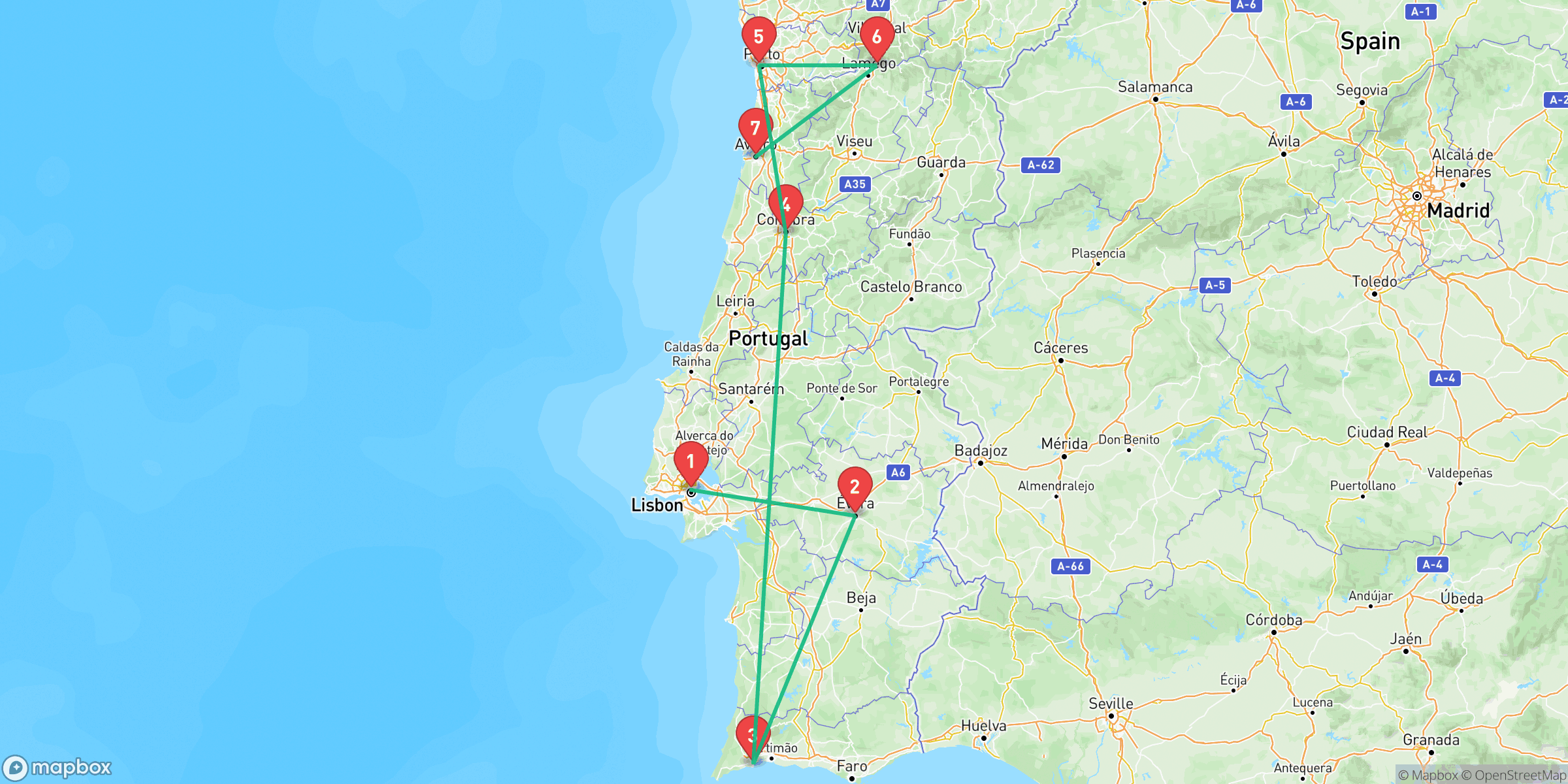
Portugal in 2 Weeks: Lisbon, Porto & the Algarve
Pastéis de nata, Atlantic cliffs, and port wine by the glass